



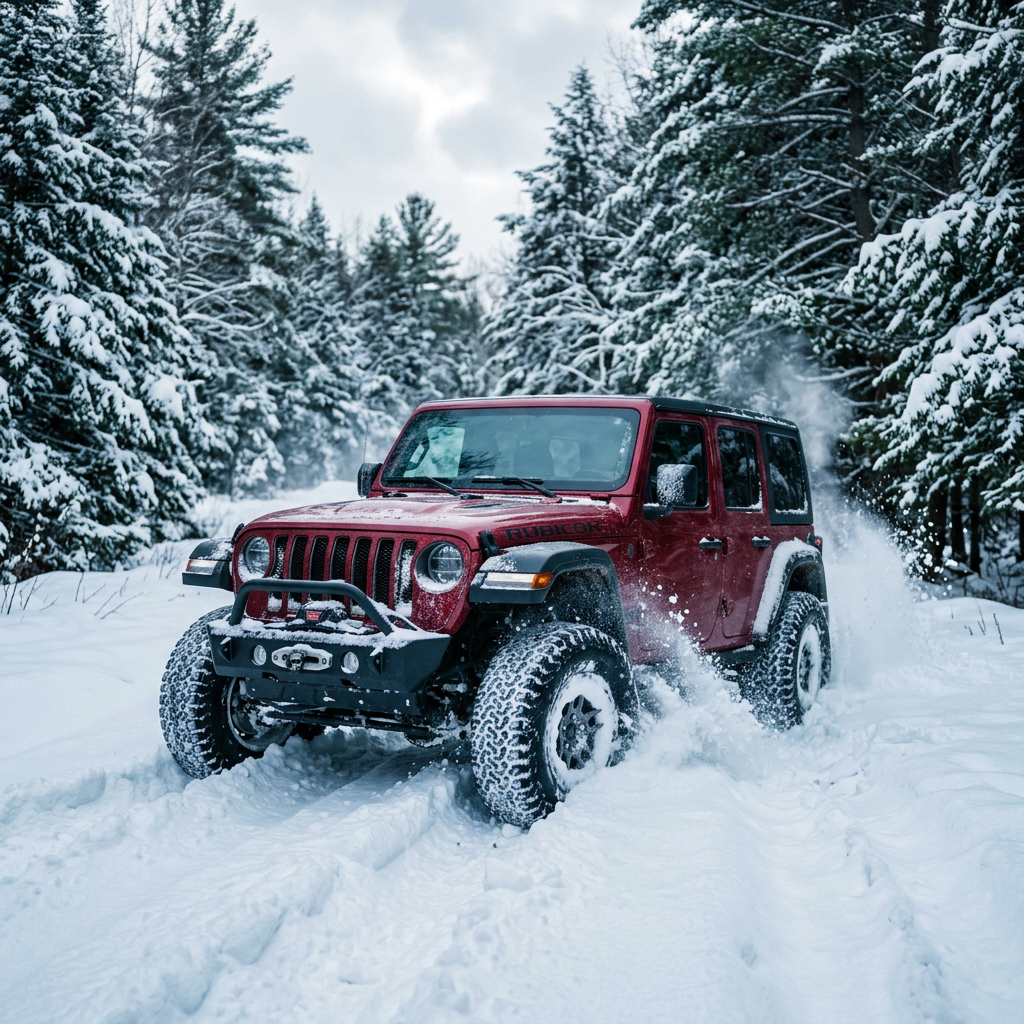
For deep snow, the Jeep Wrangler Rubicon is the stronger choice over a comparably equipped Ford Bronco. With the Xtreme 35-Inch Tire Package, the Wrangler Rubicon delivers 12.9 inches of ground clearance and 33.6 inches of water fording capability, out-clearing a Sasquatch-equipped Bronco ( 11.5 inches on the 4-door, 11.6 inches on the 2-door) and edging its 33.5-inch fording rating. Add the Rubicon's deeper 4:1 low-range gearing and solid front axle, and the Wrangler is built to keep crawling where snow gets deepest.
Navigating severe winter trails presents two major mechanical challenges: maintaining forward momentum through deep drifts and preventing the underbody frame from high-centering on hard-packed snow ruts. High ground clearance keeps skid plates clear of packed snow crusts, while mechanical 4x4 systems ensure continuous torque transfer across all four wheels.
Every Wrangler Rubicon comes ready for the trail with heavy-duty Dana 44 solid axles front and rear, Tru-Lok front and rear locking differentials, and an electronic front sway bar disconnect. The Bronco reserves its front sway bar disconnect for the Badlands and relies on an independent front suspension rather than a solid front axle. These mechanical locks force both tires on an axle to turn at identical speeds, preventing a slipping wheel from spinning helplessly in low-traction snow. Furthermore, the Wrangler's available Rock-Trac transfer case provides an aggressive 4:1 low-gear ratio, allowing drivers to crawl through heavy, wet snow with precise throttle modulation.
For drivers traversing challenging winter trails around Olean, maximum underbody clearance and robust mechanical transfer cases make a crucial difference in avoiding recovery situations. To explore trail-ready models or discuss winter vehicle preparation, visit our Olean showroom location or give our sales team a call at (716) 372-0080.
Table of Contents
- How Do the Wrangler and Bronco 4x4 Systems Compare in Deep Snow?
- How Do Solid Axles, Locking Differentials, and Independent Suspension Affect Snow Traction?
- How Do Wrangler and Bronco Clearance and Water Fording Specs Compare for Winter Trails?
- What Winter Comfort Features and Upgrades Should Wrangler Buyers Consider?
- Why Is the Jeep Wrangler the Better Choice for Deep Snow?
- Common Questions About Wrangler vs. Bronco Winter Capability
- Test-Drive a Winter-Ready Jeep Wrangler at Paul Brown Motors Inc
How Do the Wrangler and Bronco 4x4 Systems Compare in Deep Snow?
Both the Jeep Wrangler and Ford Bronco use true two-speed transfer cases with low range, but the Wrangler Rubicon's Rock-Trac transfer case delivers a deeper 4:1 low-range ratio, compared with 3.06:1 on the Bronco's Advanced 4x4 system and 2.72:1 on its standard system. That extra gear reduction multiplies engine torque for slow, controlled crawling through heavy, wet snow.
On the Jeep side, the Command-Trac part-time 4x4 system uses a 2.72:1 low range and mechanically locks the front and rear driveshafts together in 4H or 4L, ideal for pushing through unplowed drifts. Rubicon models step up to Rock-Trac, standard as a part-time system with an available full-time version. Select models offer Selec-Trac full-time 4x4, whose 4WD Auto mode automatically routes torque to the front axle when it senses slip on ice or slush, so drivers can stay in four-wheel drive across mixed winter pavement.
The Bronco's standard system is a part-time 4x4 with electronic shift-on-the-fly and a 2.72:1 low range. Its Advanced 4x4 with Automatic On-Demand Engagement, standard on Badlands and Raptor and included with the Sasquatch package, adds a 4A automatic mode and a 3.06:1 low range.
The difference shows up in crawl ratio. A Wrangler Rubicon with the 8-speed automatic delivers a 77.2:1 crawl ratio, and Jeep rates its available full-time Rock-Trac setup at up to 100:1. Ford lists a maximum of 67.8:1 for a Bronco with the 10-speed automatic and Advanced 4x4. For winter drivers, that means the Wrangler can creep through deep snow under full control with less wheelspin, which is exactly what keeps you from digging in and getting stuck.
How Do Solid Axles, Locking Differentials, and Independent Suspension Affect Snow Traction?
The Wrangler is the only vehicle in this matchup with solid axles front and rear, a layout prized by serious off-roaders for strength and simplicity in deep, frozen ruts. The Bronco pairs an independent front suspension with a solid rear axle, a design focused more on pavement manners than trail toughness.
- Jeep Wrangler Rubicon: Heavy-duty Dana 44 solid axles front and rear, Tru-Lok front and rear locking differentials, and an electronic front sway bar disconnect. A solid front axle keeps both front tires working together as one wheel drops into a snow rut, and its simple design is popular with owners who plan to lift the vehicle or add larger tires.
- Ford Bronco (Sasquatch package): A Dana 44 AdvanTEK solid rear axle and a Dana AdvanTEK independent front differential, both with electronic lockers. Its front sway bar disconnect is limited to the Badlands.
Locking differentials matter most in deep snow. With both lockers engaged, the tires on each axle turn at the same speed, so a wheel sitting on ice cannot spin uselessly while the opposite tire has grip.
How Do Wrangler and Bronco Clearance and Water Fording Specs Compare for Winter Trails?
Properly equipped, the Wrangler Rubicon offers more ground clearance and a deeper fording rating than a Sasquatch-equipped Bronco, along with deeper low-range gearing. Severe winter trail driving benefits from generous ground clearance—roughly 9 inches or more—to help prevent high-centering on frozen snow ruts.
| Model | Maximum Ground Clearance | Maximum Water/Slush Fording | Key Winter Trail Hardware |
|---|---|---|---|
| Jeep Wrangler Rubicon (Xtreme 35-Inch Tire Package) | 12.9 inches | 33.6 inches | Rock-Trac 4:1 low range, Tru-Lok front and rear lockers, sway bar disconnect |
| Ford Bronco (Sasquatch package) | 11.5 inches (4-door) / 11.6 inches (2-door) | 33.5 inches | Advanced 4x4 with 3.06:1 low range, electronic front and rear lockers |
Underbody protection also plays a vital role. Steel skid plates shield the oil pan, transfer case, and fuel tank from ice chunks and frozen debris hidden under deep snow, while high air intakes and sealed components help both vehicles Ford slush and standing water.
What Winter Comfort Features and Upgrades Should Wrangler Buyers Consider?
On most 2026 Wrangler trims, heated front seats, a heated steering wheel, and remote start are available through Jeep's Convenience Group package.
- Heated Front Seats: Warm seating surfaces quickly, before the cabin heater reaches operating temperature.
- Heated Steering Wheel: Provides direct heat to the driver's hands during freezing starts.
- Remote Start: Lets owners start the engine and begin warming the cabin and defrosting the windows remotely via key fob.
For drivers heading into heavy snow, a set of four 3PMSF-rated (Three-Peak Mountain Snowflake) winter off-road tires mounted on trail-ready wheels typically runs about $1,500 to $2,800, depending on size and brand. 3PMSF-rated rubber compounds stay flexible in freezing temperatures and grip ice far better than standard all-season or mud-terrain tires. Both the Wrangler's Xtreme 35-Inch Tire Package and the Bronco's Sasquatch package ride on factory beadlock-capable wheels, which are designed to accept an add-on beadlock ring. With the ring installed, drivers can air down further for deep snow with less risk of the tire bead slipping off the rim; without it, follow tire manufacturer guidance before lowering pressure.
Why Is the Jeep Wrangler the Better Choice for Deep Snow?
The Jeep Wrangler Rubicon wins this matchup for deep-snow driving because it combines more ground clearance, deeper low-range gearing, and tougher axle hardware than a Sasquatch-equipped Ford Bronco.
- More clearance: 12.9 inches with the Xtreme 35-Inch Tire Package vs. 11.5 inches on a 4-door Bronco Sasquatch.
- Deeper gearing: Rock-Trac's 4:1 low range vs. 3.06:1 on the Bronco's Advanced 4x4, for a 77.2:1 crawl ratio vs. 67.8:1 with automatic transmissions.
- Solid axles front and rear: Dana 44 axles with Tru-Lok lockers at both ends.
- Sway bar disconnect on every Rubicon: On the Bronco, the front disconnect is offered only on the Badlands.
- Engine choice: The Wrangler offers a 2.0L turbo four, a 3.6L Pentastar V6, and a 6.4L V8 on 392 models; the Bronco does not offer a V8.
Common Questions About Wrangler vs. Bronco Winter Capability
Q: Can the Jeep Wrangler and Ford Bronco be flat-towed behind a motorhome on winter trips?
Yes. The Wrangler's two-speed transfer cases include a neutral position for flat towing with all four wheels on the ground, and the Bronco offers a neutral tow feature on both of its transfer cases. Always follow the owner's manual procedure for your specific vehicle.
Q: How does disconnecting the front sway bar help in deep snow ruts?
Disconnecting the front sway bar lets the front suspension articulate more freely, helping keep the tires pressed against uneven, frozen ground. On the Wrangler Rubicon, the electronic disconnect works in 4H or 4L at speeds under 18 mph. On the Bronco, a front stabilizer bar disconnect is offered on the Badlands.
Q: Which is better for daily winter commuting, the Wrangler or the Bronco?
Both handle snowy commutes well. A Wrangler with Selec-Trac full-time 4x4 can stay in 4WD Auto on mixed pavement, and the Bronco's 4A mode and Slippery G.O.A.T. mode serve a similar purpose. The difference comes when the plow hasn't been through yet: the Wrangler Rubicon's 4:1 low range, standard front and rear lockers, and solid front axle give it the edge on deep, unplowed roads and trails.
Q: What underbody maintenance should be performed after driving on salted winter roads?
After driving on salted roads or muddy winter trails, a thorough undercarriage wash helps remove salt residue from frame rails, brake lines, and suspension links. Inspecting skid plates, axle breathers, and driveshaft boots ensures packed ice or debris has not damaged vital seals.
Q: What roadside help is available for Jeep owners on winter roads?
Eligible new Jeep vehicles include manufacturer-backed roadside coverage for towing, battery jump-starts, and flat tire assistance through Chrysler, Dodge, Jeep and Ram Roadside Assistance: 1-800-521-2779.
Test-Drive a Winter-Ready Jeep Wrangler at Paul Brown Motors Inc
Our team at Paul Brown Motors Inc knows why the Jeep Wrangler remains the benchmark for harsh Western New York winters, and we're happy to show you how it stacks up against the Ford Bronco on a test drive. Whether you need a daily commuter with full-time 4x4 or a dedicated trail rig, our inventory specialists can walk you through every 4x4 system, option package, and tire setup.
Our showroom features the trail-tested 2026 Jeep Wrangler Rubicon, available with the 2.0L turbocharged four-cylinder or 3.6L Pentastar V6, alongside other winter-ready Jeep models such as the 2026 Grand Cherokee and three-row 2026 Grand Cherokee L. Contact our team for current pricing and availability.
To schedule a test drive or explore current vehicle options, call our team at (716) 372-0080 or visit our Olean showroom today.
© 2026 Paul Brown Motors Inc. All rights reserved.